
Audio

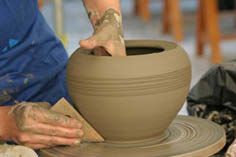 Recall when God brought Jeremiah's attention to the potter's disk (Jer. 1 Dec.8,2-6)? God used the image of the potter and the clay to teach us a powerful lesson. Similar messages using the image of the potter and the clay are found in Isaiah 45,9 and 64,7 as well as in Romans 9,20.
One of my favorite cups, which I often use to drink tea in my office, carries a picture of my family. As I'm looking at her, she reminds me of the story of the talking teacup. The story is told from the teacup in the first person, and explains how she became what her creator was up to.
I wasn't always a nice teacup. Originally I was just a shapeless lump of sodden clay. But someone put me on a disk and started spinning the disk so fast that I felt dizzy. As I turned in circles, he squeezed, squeezed and tore me. I shouted: "Stop!" But I got the answer: “Not yet!”.
Finally he stopped the window and put me in the oven. It got hotter and hotter until I screamed: "Stop!". Again I got the answer “Not yet!” Finally he took me out of the oven and started to apply paint to me. The smoke made me sick, and again I yelled: "Stop!". And once again the answer was: “Not yet!”.
Then he took me out of the oven and after I had cooled down, he put me on the table in front of a mirror. I was surprised! The potter had made something nice out of a worthless clump of clay. We are all clumps of clay, right? By placing us on the potter's wheel of this earth, our Master Potter makes us the new creation that we should be to his will!
Speaking of the hardships of this life that seem to meet us so often, Paul wrote: “Therefore we do not grow weary; but though our outward man decays, yet the inward man is renewed day by day. For our affliction, which is temporary and light, creates an eternal and exceeding glory for us, who do not look at the visible but at the invisible. For what is visible is temporal; but what is invisible is eternal" (2. Corinthians 4,16-17).
Our hope lies in something that is outside and beyond this present world. We trust the Word of God, we find our present tribulations easy and timely compared to what God has in store for us. But these trials are part of the Christian way of life. In Romans 8,17-18 we read: “But if we are children, then we are also heirs, that is, heirs of God and joint heirs with Christ, if we suffer with him, so that we too may be exalted to glory. For I am persuaded that the sufferings of this time are not worth comparing with the glory that is to be revealed to us.”
We share in the sufferings of Christ in many ways. Some, of course, are martyred for their beliefs. However, most of us share in the sufferings of Christ in other ways. Friends may betray us. People often get us wrong, they don't value us, they don't love us or they even abuse us. Still, as we follow Christ, we forgive as he forgave us. He sacrificed himself when we were his enemies (Rom. 5,10). This is why he calls us to make extra effort to serve people who abuse us, do not value us, do not understand us, or do not like us.
Only "because of God's mercy" are we called to be "living sacrifices" (Rom. 1 Cor2,1). God is active in us through the Holy Spirit to transform us into the image of Christ (2. Corinthians 3,18), something immeasurably better than a lump of sodden clay!
God is active in each of us in action, in all the events and challenges that our lives involve. But beyond the difficulties and trials we encounter, whether they involve health or finances or the loss of a loved one, God is with us. He perfects us, changes us, shapes and shapes us. God will never leave us or miss us. He is with us in all battles.
by Joseph Tkach
This website contains a diverse selection of Christian literature in German. Translation of the website by Google Translate.
