
Audio

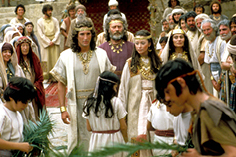 One story in the Old Testament particularly fascinates me. The main actor is called Mefi-Boscheth. The people of Israel, the Israelites are in battle with their archenemy, the Philistines. In this particular situation they were defeated. Their King Saul and his son Jonathan died. The news reaches the capital, Jerusalem. Panic and chaos break out in the palace because it is known that if the king is killed, his family members could also be executed to ensure that there is no future uprising. It so happened that at the moment of general chaos, the nurse of the five-year-old Mefi-Boscheth took him with her and escaped from the palace. In the hustle and bustle that prevailed in the place, she lets him fall. He remained paralyzed for the rest of his life.
“Jonathan, Saul's son, had a son who was lame on both feet; for he was five years old when the news of Saul and Jonathan came from Jezreel, and his nurse had picked him up and fled, and while she was fleeing quickly he fell down and was lame from then on. His name was Mefi-Boscheth »(2. Sam 4,4).
Remember, he was royal and the day before, like any five-year-old boy, he was walking around the palace with no worries. But on this day his whole fate changes suddenly. His father and grandfather were killed. He himself is dropped and for the rest of his days is paralyzed and dependent on help from other people. With his pain, he will live in a dreary, isolated place for the next 20 years. This is the Mefi-Boscheth drama.
What does the story of Mefi-Boscheth have to do with you and me? Like him, we are more disabled than we think. Your feet may not be paralyzed, but your mind may be. Your legs may not be broken, but, as the Bible says, your spiritual condition. When Paul speaks of our desperate condition, he goes beyond being paralyzed: "You too were dead from your transgressions and sins" (Ephesians 2,1). Paul says we are helpless whether you can confirm this, believe it or not. The Bible says that unless you are in a close relationship with Jesus Christ, your situation is that of one spiritually dead.
«For Christ died for us wicked even when we were weak. But God shows his love for us in the fact that Christ died for us while we were still sinners »(Romans 5,6 and 8).
There is absolutely nothing you can do to fix the problem. It doesn't help to try harder or get better. We are completely disabled, more than we think. The plan of King David, a shepherd boy who tended the sheep, is now on the throne as King of Israel in Jerusalem. He was Jonatan's best friend, Mefi-Boscheth's father. David not only accepted the royal throne, but also won the hearts of the people. He expanded the kingdom from 15.500 km2 to 155.000 km2. The people of Israel lived in peace, the economy was good, and tax revenues were high. Life couldn't have been better.
I imagine David got up earlier that morning than anyone else in the palace. He walks leisurely out into the courtyard and lets his thoughts wander in the cool morning air before the pressures of the day take up his mind. His thoughts move back to the time he spent many hours with his loyal friend Jonathan, whom he had not seen in a long time because he had been killed in battle. Then David remembers a conversation with him out of a blue sky. At that moment David was overwhelmed by God's goodness and grace. Because none of this would have been possible without Jonathan. He remembers a conversation they had when they reached a mutual agreement. In it they promised each other that each of them should take care of each other's families, no matter where the further journey of life might lead them. At that moment David turns around, goes back to his palace and says: "Is there anyone left of Saul's house that I may show mercy to him for Jonathan's sake?" (2. Sam 9,1). But it was a servant from the house of Saul whose name was Ziba, and they called him to David. Ziba said to the king: There is still a son of Jonathan, lame on his feet "(2. Sam 9,3).
David does not ask, is there anyone else who is worthy? David simply asks: Is there anyone? This question is an expression of kindness. From Ziba's answer you can tell: I'm not sure that he has royal qualities. «The king said to him: Where is he? Ziba said to the king: Behold, he is in Lo-Dabar in the house of Machir the son of Ammiël »(2. Sam 9,4). The name literally means, no pastureland.
The perfect, the holy, the righteous, the almighty, the infinitely wise God, the Creator of the whole universe, runs after me and runs after you. We speak of searching people, people on a spiritual journey to discover spiritual realities. In reality, God is the seeker. We see this in all of the Scriptures. At the beginning of the Bible begins the story of Adam and Eve, where they hid from God. In the cool of the evening God comes and looks for Adam and Eve and asks: Where are you? After Moses made the tragic mistake of killing an Egyptian, he had to fear for his life for 40 years and fled into the desert. There God looks for him in the form of a burning bush and arranges a meeting with him. In the New Testament we see Jesus meeting twelve men and patting them on the shoulder and saying: Would you like to join my cause?
«For in him he chose us before the foundation of the world was laid that we should be holy and blameless before him in love; he predestined us to be his children through Jesus Christ according to the pleasure of his will, to praise his glorious grace with which he graced us in the beloved »(Ephesians 1,4-6)
Our relationship with Jesus Christ, salvation, is given to us by God. It is controlled by God and initiated by God. It was created by God. Back to our story. David has now sent a group of men to Lo-Dabar on the barren outskirts of Gilead to look for Mefi-Boscheth. He lives in isolation and anonymity and did not want to be found. But he was discovered. They put Mefi-Boscheth in the car and drive him back to the capital, to the palace. The Bible tells us little or nothing about this chariot ride. But I'm sure we can all imagine what it would be like to sit down on the floor of the car. What emotions Mefi-Boscheth must have felt on this trip, fear, panic, uncertainty. The car drives in front of the palace. The soldiers carry him in and place him in the middle of the room. He kind of struggles with his feet and David walks in.
“When Mephibosheth, son of Jonathan, son of Saul, came to David, he fell on his face and paid homage to him. And David said, Mephibosheth! He said, Here I am, your servant. “David said to him, Do not be afraid, for I will show you mercy for the sake of Jonathan your father, and I will give you back all your father Saul's possessions; but you are to eat at my table every day. But he fell down and said: Who am I, your servant, that you should turn to a dead dog like me? " (2. Samuel 9,6-8).
He understands that he is a cripple. He has nothing to offer David. But that's what grace is about. The character, the nature of God, is the tendency and disposition to give kind and good things to unworthy people. But let's be honest. This is not the world most of us live in. We live in a world that says: I demand my rights and give people what they deserve. Most kings would have executed a potential heir to the throne. In sparing his life, David showed mercy. He showed him mercy by showing him mercy.
Now that we are accepted by God on the basis of faith, we are at peace with God. We owe this to Jesus Christ our Lord. He opened the way of trust for us and with it access to the grace of God, in which we have now gained a firm footing (Romans 5,1-2).
Like Mephibosheth, we have nothing to offer God except gratitude: «To praise his glorious grace with which he has graced us in the Beloved. In him we have redemption through his blood, the forgiveness of sins, according to the riches of his grace »(Eph1,6-7).
All of the guilt is forgiven. So God showed us the riches of His grace. How great and rich is the grace of God. You either haven't heard the word yet or you refuse to believe it's true. It is the truth because you are loved and God has followed you. As believers, we had a grace encounter. Our lives changed through the love of Jesus and we fell in love with Him. We didn't deserve it. We weren't worth it. But Christ offered us this most wonderful gift of life. That's why our life is different now. The story of Mefi-Boscheth could end right here, and it would be a great story.
The same boy had to live in exile as a refugee for twenty years. His fate has undergone a radical change. David said to Mefi-Boscheth: "Eat at my table like one of the king's sons" (2. Samuel 9,11).
Mefi-Boscheth is now part of the family. I like the way the story ends because it seems like the writer put a little postscript at the end of the story. We are talking about how Mefi-Boscheth experienced this grace and is now supposed to live with the king and that he is allowed to eat at the king's table.
Imagine the following scene years later. The bell rings in the king's palace and David comes to the main table and sits down. Shortly afterwards, the cunning, cunning Amnon sits down on David's left side. Then Tamar, a beautiful and friendly young woman, appears and sits down next to Amnon. On the other hand, precocious, brilliant, lost in thought Solomon slowly emerges from his study. Absalom with flowing, shoulder-length hair takes a seat. That evening Joab, the brave warrior and troop commander, was invited to dinner. However, one seat is still vacant and everyone is waiting. You hear shuffling feet and the rhythmic sound of crutches. It is Mefi-Boscheth who is slowly making his way to the table. He slips into his seat, the tablecloth covers his feet. Do you think Mefi-Boscheth understood what grace is?
You know, that describes a future scene when the whole family of God will gather in heaven around a great banquet table. On this day the tablecloth of God's grace covers all of our needs. You see, the way we come into the family is by grace. Every day is a gift of His grace.
"As you have now accepted the Lord Christ Jesus, so also live in him, rooted and founded in him and firm in the faith, as you have been taught, and full of gratitude" (Colossians 2,6-7). They received Jesus by grace. Now that you are in the family, you are in it by grace. Some of us think that once we become Christians by grace, we must work extra hard and make God right to make sure he continues to like and love us. Yes, nothing could be further from the truth.
Not only did God give you Jesus so you could come into His family, but He gives you everything you need now to live a life of grace once you are in the family. «What do we want to say about this now? If God is for us, who can be against us? Who did not spare his own son either, but gave him up for all of us - how should he not give us everything with him? " (Romans 8,31-32).
How do you react when you are aware of this fact? What is your response to God's grace? What can you do to help? The apostle Paul speaks of his own experience: “But by God's grace I am what I am. And his grace in me has not been in vain, but I have worked much more than all of them; but not I, but God's grace that is with me »(1. Corinthians 15,10).
Do we who know the Lord live a life that reflects grace? What are some of the characteristics that indicate my life of grace? Paul gives the answer to this question: "But I do not consider my life worth mentioning if I only complete my course and carry out the office that I received from the Lord Jesus, to testify to the Gospel of the grace of God" (Acts of the Apostles 20,24). That is a life's mission.
Like Mefi Boscheth, you and I have been broken spiritually and dead spiritually. But like him, we have been followed because the King of the Universe loves us and wants us to be in his family. He wants us to share the good news of His grace through our lives.
by Lance Witt
This website contains a diverse selection of Christian literature in German. Translation of the website by Google Translate.