
Virgin birth of Jesus
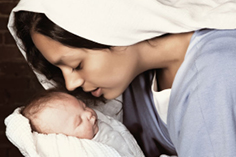 Jesus, the eternally living Son of God, became a man. Without this event, there can be no true Christianity. The Apostle John put it this way: “By this you can recognize the Spirit of God: Every spirit that confesses that Jesus Christ has come in the flesh is from God, and every spirit that does not confess Jesus is not from God. This is the spirit of the antichrist, which you have heard is coming and is now in the world.” (1. Joh. 4,2-3).
The virgin birth of Jesus declares that the Son of God became fully human while he remained what he was - the eternal Son of God. The fact that the mother of Jesus, Mary, was a virgin, was a sign that she would not become pregnant through human initiative or participation. The salutary conception in the womb of Mary was through the working of the Holy Spirit, who united the human nature of Mary with the divine nature of the Son of God. The Son of God thereby took on all human existence: from birth to death, to the resurrection and ascension, and now lives forever in his glorified humanity.
There are people who make fun of the conviction that the birth of Jesus was a miracle of God. These skeptics denounce the biblical record and our belief in it. I find their objections quite paradoxical, for while they consider the virgin birth an absurd impossibility, they represent their own version of a virgin birth in the context of two basic claims:
1. They claim that the universe arose spontaneously, from nothing. I mean, we have the right to call that a miracle, even if it's said to have come about unintentionally and without purpose. However, if we examine their notions of nothingness more closely, it becomes clear that it's a figment of their imagination. Their nothingness is redefined as something like quantum fluctuations in empty space, cosmic bubbles, or an infinite accumulation of the multiverse. In other words, their use of the term nothingness is misleading, since their nothingness is filled with something—the very something from which our universe emerged!
2. They claim that life arose from inanimate matter. To me, this claim is far more far-fetched than the belief that Jesus was born of a virgin. Despite the scientifically proven fact that life comes only from life, some manage to believe that life originated in a lifeless primordial soup. Although scientists and mathematicians have pointed out the impossibility of such an event, some find it easier to believe in a meaningless miracle than in the true miracle of the virgin birth of Jesus.
Although skeptics advocate their own models of virgin birth, they consider it a fair play to mock Christians because they believe in the virgin birth of Jesus, which requires a miracle of a personal God permeating all of creation. Does one not have to assume that those who regard the incarnation as impossible or unlikely apply two different standards?
Holy Scripture teaches that the virgin birth was a miraculous sign from God. (Jes. 7,14), which was destined to fulfill his purposes. The repeated use of the title "Son of God" confirms that Christ was conceived and born of a woman (and without the involvement of a man) through the power of God. That this actually happened is confirmed by the Apostle Peter: For we did not follow cleverly devised myths when we made known to you the power and coming of our Lord Jesus Christ, but we ourselves were eyewitnesses of his glory. (2. Petr. 1,16).
The testimony of the Apostle Peter provides a clear, conclusive refutation of all claims that the account of the incarnation, including the virgin birth of Jesus, is a myth or a legend. The fact of the virgin birth testifies to the miracle of a supernatural conception through God's own divine, personal act of creation. The birth of Christ was natural and normal in every respect, including the entire period of human pregnancy in the womb of Mary. In order for Jesus to redeem every aspect of human existence, he had to take on everything, overcome all weaknesses, and regenerate our humanity from start to finish. In order for God to heal the fault that evil had brought between him and the people, God had to undo in himself what humanity had done.
For God to reconcile with us, he had to come himself, reveal himself, accept ours, and then bring us to himself, starting from the true root of human existence. And that is exactly what God has done in the person of the eternal Son of God. While he remained fully God, he became perfectly one of us, so that in and through him we can have a relationship and communion with the Father, in the Son, through the Holy Spirit. The author of the Letter to the Hebrews points to this amazing truth in the following words:
Since the children have flesh and blood, he also received the same fate, so that by his death he might break the power of him who holds the power of death, that is, the devil, and redeem those who all their lives were slaves to the fear of death. For he does not help the angels, but the children of Abraham. Therefore he had to be made like his brothers in every way, so that he might become a merciful and faithful high priest in the service of God, to atone for the sins of the people. (Hebr. 2,14-17).
At his first coming, the Son of God, in the person of Jesus of Nazareth, literally became Immanuel (God with us, Matth. 1,23The virgin birth of Jesus was God's announcement that he would set everything in human life right from beginning to end. At his second coming, which is yet to come, Jesus will overcome and conquer all evil by putting an end to all suffering and death. The Apostle John expressed it this way: And he who was seated on the throne said, “Behold, I am making all things new.” (Offb. 21,5).
I saw adult men crying and witnessing their baby's birth. Sometimes we rightly speak of "the miracle of birth". I hope you see the birth of Jesus as the miracle of the birth of the One who really "makes everything new".
Let us celebrate together the miracle of the birth of Jesus.
Joseph Tkach
President
GRACE COMMUNION INTERNATIONAL

